

Customer Call Analysis
1. Business Context and Objectives
Traditional call center quality assurance relies on manual sampling of 1-3% of calls, creating inconsistent evaluation standards, delayed feedback loops, and missed opportunities for improvement. Human reviewers introduce subjective bias, struggle with emotional nuance detection, and cannot process the volume needed for comprehensive insights. This leads to poor customer experience, agent performance gaps, compliance risks, and inability to extract actionable intelligence from customer interactions. AI-powered call analysis transforms every customer interaction into structured data, enabling real-time quality monitoring, predictive insights, and systematic knowledge capture.
2. Practical Example
Real-World Scenario: A telecommunications company’s customer service center handling 50,000 calls daily across billing, technical support, and sales inquiries.
How It Works:
- The AI automatically transcribes every call with 95%+ accuracy, identifying speakers and capturing emotional tone markers throughout the conversation
- Performs real-time sentiment analysis detecting frustration escalation patterns, satisfaction indicators, and emotional journey mapping from greeting to resolution
- Generates comprehensive call summaries highlighting key issues, resolution steps, outcome classifications, and next action items
- Extracts recurring problem patterns to create new knowledge base articles, FAQ updates, and training materials automatically
- Scores calls against 20+ quality metrics including empathy, resolution effectiveness, compliance adherence, script following, and upselling appropriateness
- Flags high-risk calls for immediate supervisor review (angry customers, potential churn, compliance violations, legal threats)
- Creates personalized coaching recommendations for each agent based on their specific performance patterns and improvement areas
Practical Output: The system delivers insights like “Agent Sarah: 94% customer satisfaction score, excels at technical explanations but needs improvement in active listening (interrupted customers 12 times this week). Recommend Module 3 training. Top customer pain point: billing confusion around new 5G charges – create knowledge article #KB-2024-156. Customer ‘John Smith’ expressed high frustration about recurring billing errors – immediate retention team follow-up required within 2 hours.”
3. Key Capabilities
- Multi-language transcription with speaker identification and emotional tone detection
- Real-time sentiment analysis with escalation pattern recognition and churn prediction
- Automated quality scoring across customizable metrics with trend analysis
- Knowledge extraction for FAQ generation and training material creation
- Compliance monitoring for regulatory requirements and script adherence
- Integration with CRM systems, workforce management platforms, and training tools
4. Functional Workflow
Call Recording Ingestion → Speech-to-Text Transcription → Speaker Identification →
Sentiment Analysis → Quality Scoring → Knowledge Extraction →
Compliance Checking → Alert Generation → Performance Analytics →
Coaching Recommendations → Knowledge Base Updates
5. Target Users & Stakeholders
RoleUsage / BenefitsCall Center AgentsReal-time coaching alerts, personalized performance feedbackQuality Assurance Teams100% call coverage, consistent scoring standardsSupervisors/Team LeadsImmediate escalation alerts, data-driven coaching insightsTraining DepartmentsKnowledge gap identification, curriculum optimizationCustomer Experience TeamsSentiment trends, pain point identificationCompliance OfficersRegulatory adherence monitoring, risk mitigationExecutive LeadershipPerformance dashboards, strategic customer insights
6. Technical Architecture
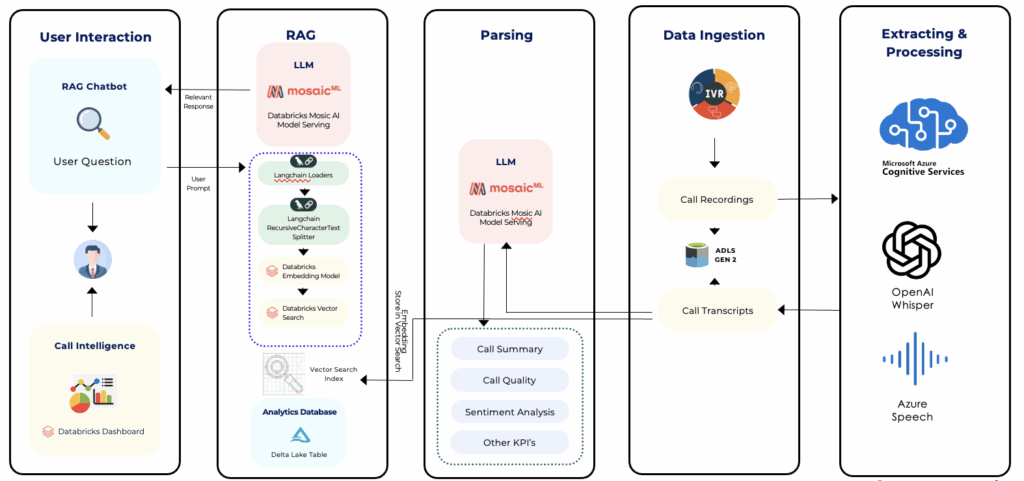
Core Components:
- Speech recognition engine with noise cancellation and multi-speaker identification
- Natural language processing pipeline for sentiment analysis and intent classification
- Quality scoring engine with customizable rubrics and weighted metrics
- Knowledge extraction system using named entity recognition and topic modeling
- Real-time analytics platform with alerting and notification capabilities
- Integration APIs for CRM, workforce management, and contact center platforms
Optional Enhancements:
- Predictive analytics for customer churn and lifetime value assessment
- Voice biometrics for caller authentication and fraud detection
- Emotion AI for advanced psychological state analysis
- Conversational AI recommendations for agent assistance during calls
7. Data Flow and Sources
| Data Type | Source | Usage |
| Audio Recordings | Contact Center Platform | Primary transcription and analysis |
| Customer Data | CRM Systems | Context enrichment, personalization |
| Agent Profiles | HR/Workforce Management | Performance benchmarking |
| Knowledge Base | Internal Documentation | Content gap identification |
| Compliance Rules | Regulatory Guidelines | Adherence monitoring |
| Historical Interactions | Customer Journey Data | Pattern recognition |
8. Value Delivered
| Metric | Before AI | After AI |
| Call Coverage for QA | 1-3% | 100% |
| Quality Score Consistency | 60-70% | 95%+ |
| Coaching Feedback Delay | 1-2 weeks | Real-time |
| Knowledge Base Updates | Monthly | Daily/Real-time |
| Compliance Risk Detection | 5-10% | 85-90% |
| Agent Performance Improvement | 10-15% annually | 25-30% quarterly |
| Customer Satisfaction | Baseline | 15-20% improvement |
9. Deployment Models
- Cloud-native SaaS with contact center platform integration
- On-premise deployment for data sovereignty and security requirements
- Hybrid model with edge processing for real-time analysis and cloud analytics
- Multi-tenant architecture supporting multiple business units and regions
10. Challenges and Considerations
- Audio quality variations affecting transcription accuracy
- Privacy regulations and data retention compliance (GDPR, CCPA)
- Integration complexity with legacy contact center systems
- Agent acceptance and change management for AI-driven feedback
- Multi-language support and cultural context understanding
- Real-time processing latency for immediate alerts and coaching
11. Potential Extensions
- Predictive call routing based on customer sentiment and agent expertise
- Automated call summarization for CRM integration and follow-up actions
- Voice-based customer authentication and fraud detection capabilities
- Conversational AI recommendations for real-time agent assistance
- Cross-channel analysis incorporating chat, email, and social media interactions
12. Business Case
- Efficiency Gains: 90% reduction in manual QA time, automated coaching recommendations saving 20 hours per supervisor weekly
- Cost Savings: $2-3M annually through improved first-call resolution (15% improvement), reduced training costs (40% reduction), and compliance risk mitigation
- Revenue Impact: $8-12M additional revenue through better customer retention (5% churn reduction) and improved sales conversion (20% increase)
- Quality Improvements: 25% increase in customer satisfaction scores, 30% reduction in escalated complaints, 50% faster issue resolution
- Total Cost of Ownership: $1.5-2.5M (platform $800K, integration $500K, training $200K, annual licensing $400K)
- ROI Analysis: 300-450% first year ROI based on cost savings and revenue protection
- Payback Period: 4-8 months
- Sensitivity Analysis: 80% agent adoption required for full benefits, 10% improvement in call quality still delivers 150% ROI